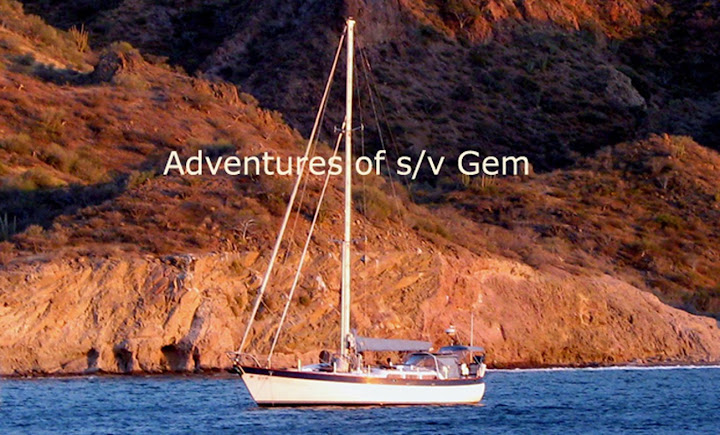
Life at the Dock; Life on the Hook

I’ve noticed some marked differences in living on a boat. The most notable is where the boat is tied up. One type of living is when the boat is at a dock or marina, while the other type is when the boat is at anchor or ‘on the hook’. Each has its distinct flavor and in reality, seems like a totally different life. Here is a typical day of each.


Life at the Dock


8am Get up to listen to the net if you’re not already up. Channel 22A on the VHF radio is a neighborhood chat of cruisers. We learn about today’s weather, which boats are coming and going, who has something to trade for ‘coconuts’ (talking of money would be business and is not allowed in a foreign country), where the music is for the evening, how to get anything done by local suppliers, and anything else that you would like to ask ‘the fleet’.
9:30 Coffee social at the club house, talking to other cruisers, buy tamales, rent DVD’s
10:30 E-mail, Work on the boat.
1:30 Walk or bicycle to a small restaurant for ‘plata corrida’ or special of the day which includes an entre, salad, rice and maybe desert for $4.50.
2:30 Work on the boat.
5:00 Kayak ride for Jill.
7:00 E-mail. Go for a walk on the malecón which is a wide sidewalk along the beach, or get a bite to eat, or listen to music.
10:00 Bed time or watch a movie.
 
Life on the Hook (Anchor)
Note: Times not listed because there aren’t any specific times for anything


Wake up with the first sign of light and make a cup of herbal tea. Take this to the cockpit and watch the sun rise appreciating the lack of sound and being in the center of the natural world.
Go for a meander in the kayak.
Make lunch.
Go diving, canyon walking, beach walking, shallow water walking.
Read or work on the computer or cook a meal, or organize an area of the boat, read a book. Maybe talk with the folks of another boat.
Eat a snack. Clean up the boat.
Watch the sun set.
Watch a movie.
Watch the stars.
Go to bed.


Living on the same boat with totally different life styles. To me it’s amazing.

Carnival LaPaz 2009


Isla Espiritu Santo and Isla Partida

Late February 2009


Since the outside cushions are in the process of being made, the dinghy is back with its new shiny ‘chaps’ to protect it from the sun, and the water pump is making its way from the border customs office, we will finally be able to get away form the dock. Even if it’s only for one week. Besides, we want to make it back for carnival which is the following week.

Once we left LaPaz, it was about 4 ½ hrs. of motoring, about 24 miles going north to get to Isla Espiritu Santo and Isla Partida. The interesting thing about these two islands is that it was once one island of about 19 miles. A volcano erupted on the northern portion of the one island separating it from the southern section. This created a large hole which filled with water ultimately making a great anchoring place. We shared the anchorage with only a handful of boats during our 6-day stay. We managed to dive (our first) on a very tired reef near our anchorage. Tired, I believe, because as we learned at the Seymour Marine Discovery Center in Santa Cruz, 1/3 of the world’s reefs have been destroyed in the last 20 years as a result of the La Ninas and El Ninos. The reefs haven’t been able to adapt to these brief warmer water temperatures fast enough. Here is a photographic taste of what it is like to anchor in these islands.

LaPaz, Baja Mexico


One of the many sculptures on the board walk (‘malecón’ in Spanish) in LaPaz.

This is one by creator Guillermo Gómez Macías . At the base of the sculpture there is a poem.


I have a paper boat

It’s made from a page

On which I have written my dreams
It has neither anchors, nor mooring ropes
I want to sail in it
On the seven seas; in the eighth

I know I will run aground in the port of my desires.

Has someone ever seen the light shining from their lighthouse?


Photos: Downtown LaPaz from one point: Up the coast, toward town, and down the coast.

Fixing Things in Exotic Ports

Also February 2009

I don’t have to tell all you sailors. You already know. For all you non-sailor readers that think this is an exotic life, I want you to see a glimpse of real life.

All the way down the coast, we added needed items to the boat. Biagio calls some of these things ‘real things’ i.e. engine parts, etc. and the other things are stuff’. That would be the things a female would like on a boat such as Tupperware, shoe holders and laundry separators. You get the gist. For my part, I call it all ‘stuff’. Now there was a big rush on the boat of ‘stuff’ in San Francisco where we stayed for a month. Then there was the final ‘stuff’ loaded onto the boat in San Diego. Mosquito nets, sun screen mesh, bicycle baskets, extra parts, etc. With such preparation you would think that all the ‘stuff’ got on the boat and that would be the end of it. You would think.

Photos: The repairs in a 24 hr. period: Left - Major bicycle repair requiring several trips to the bicycle store after we were able to find one; Center - A bird broke off the radio antenna which required a trip to the store for a new one and several more trips to find the right coupling, Lower right - A stanchion was bent when single handing onto the windy LaPaz dock. Lower - Trouble shooting the battery charger before resting it in peace and finding a replacement.

In reality, the water maker didn’t work all the way down the coast. We should have started it in San Diego. But we didn’t. Hey, it always works. Until now. We’re still waiting for the rebuilt pump to come from San Diego as noted in an earlier vignette. And then the battery charger went out. One night after shutting down a computer, there was a soft 'boom' sound. "Hey Biag, I heard something." "What did you hear,” he said? "Something," I said. "I didn’t hear anything", he said. "No it was something", I insisted. Well, we later found that ‘something’ was a battery charger which had come to a dead stop. The battery charger charges our batteries which gives us the power to operate our fans, computers, tv, boy are we spoiled! Well now we have to run the generator to charge it all. Until the new battery charger is installed. Biagio had to scour the car engine stores to get one strong enough to replace the one we had. So now what’s next? Well that is after we get the pump back for the water maker. Maybe then it will be the motor for the water maker. Now remember we still don’t have fresh water. It’s always something. That’s boat life. So all of you who think this is the ideal life, just remember, all that fixing you’re missing out on. Well that and the dolphins and whales, and the exotic tacos and 'platos corridos', and the walks along the shore, and the diving. Well, I guess it’s worth it. Just don’t tell Biagio. He’s got his head under the navigation table trying to fix the latest malfunction.

The Vortex of LaPaz, Mexico

February 2009
(To orient you, LaPaz is the first stop into the Sea of Cortez after Cabo San Lucas. It's on the west side of of the Sea. From here we'll go north into the islands for some diving and fishing.)

Like quick sand, did you ever get stuck into something you couldn't get out of? LaPaz is a lot like that. With 80 degree temperatures during the day in February, and 55 degrees at night for cool evening walks, it's very easy to hang out here. One person said, "I've been here for a couple o f years and I'm leaving any day now." I heard another say, "We just came down for a sail and wound up buying a house. We've been here for 3 years now."

It starts out by listening to the 'net' in the morning. It's like an active newspaper of the morning. Someone gives a weather report, someone else tells what's going on in town, another about what meetings might be of interest, who has something to trade, what get togethers you can get together at, etc.


Photos: Left-Marina de LaPaz, Right-Super Bowl Sunday al frescoe at Bandito's Restaurant. (note the very large screen)

Our stay started out like this:
Waiting for the pump from Seattle via DHL
Decided to have cover made to protect the dinghy. This will take one week.
Go to the blues bar to hear music. Meet 3 new couples.
Go to the 'how to organize your food' meeting. Meet 20 new women.
Go to the club house to rent a video and have a coffee. Meet 10 of the women you already know.
Walk down the malecon. Meet 2 couples you previously met.
Invitation to someone's house. They arrived 10 years ago.
And so it goes.

Any day now, just as soon as the dinghy cover is ready, we're going to leave. Honest.

Sailing Recap 2008

Jill joins boat in Victoria, BC, Canada - July 15
Leave Victoria BC, Canada – Aug 1
Otter Bay, Pender Island, Canada – Aug 1 – engine breakdown
Vancouver, Canada – Aug 2 – 4 With Terry and Lynn, Matthew & Annie
Orcas Island & Stewart Islands, USA - Aug 5 – 7 With Jess & Tracy
Victoria, BC, Canada – Aug 7 - 14
Port Angeles, USA – Aug 15
Neah Bay, Washington, USA – Aug 16 - 22
Eureka, CA, USA – Aug 23 - Sept 13 w/ 2 overnight passage
Emeryville (SanFrancisco), CA, USA – Sept 15 – Oct 15, 1 overnight passage, visit f/ Doug & Lucy
Santa Cruz, CA, USA – Oct 17 – 20 w/ 1 overnight passage
Morro Bay, CA, USA – Oct 22 - 24
Monterey Bay, CA USA – Oct 25 – 26 w/ 1 overnight passage
Santa Barbara, CA, USA – Oct 28 -Nov 1 w/ 1 overnight passage
Long Beach, CA, USA - Nov 3 – 6 w/ 1 overnight passage
San Diego, CA, USA – Nov 7, 2008 – Jan 7, 2009
Map also shows Mexico portion (green markers) in 2009
Turtle Bay, Baja, Mex - Jan 11, 2009
Cabo San Lucas, Baja, Mex - Jan 15, 2009
Los Frailes, Baja, Mex - Jan 20, 2009
LaPaz, Baja, Mex - Jan 25, 2009

(Click on any image to enlarge)

A Close Brush with Mexican Security

Later Still January 2009
(Location: Cabo San Lucas to LaPaz. Matt has gone on to more adventures with his wife Anne in the Dominican Republic. Biagio has taken the boat from Cabo San Lucas to LaPaz by himself while I am taking the water pump to be repaired and also attend a seminar.)

You can spend weeks going down the Baja Coast from San Diego to Cabo San Lucas stopping and exploring along the way. We hurried down the stretch of desert in a very fast 8 days stopping only once to go kite surfing with Matt and also filling up with fuel. We wanted to fill up with water but it was so windy with Santa Ana winds blowing up to 60 knots from land spilling out to the bay that we weren’t able to get any unless we stayed an extra day. During the entire trip we weren’t able to make any water with our water maker.

I took the opportunity to go back to San Diego with the pump. I flew from Cabo to Tijuana and then crossed the border and took the trolley to Jesse and Tracy’s house to stay with them.

Now Mexico is having quite a struggle with drugs within their borders. I’ve never seen bags get x-rayed at the airport in Cabo and then a zip tie to secure the bags. OK, a little excessive with the zip tie. But then when I got off the plane in Tijuana, we had to take the bags to get x-rayed again before we could leave with them. So in the bottom of my bag was the pump for the water maker. The guards asked me what that object was. Since I imported/exported some cars while I lived in Chile, I knew some strange words for fixing mechanical things. Pump. Pump. Pump. Not let me see, what was that word. I was scratching my memory from 12 years ago when I lived there. Oh, I know, bomb. Or ‘bomba’ in Spanish. Oh no, that can’t be right. They call it a bomb. Well maybe I’m wrong. No, I think that’s right. So how do I tell them it’s a bomb?

Photo: Water Maker Unit. Blue cylinder is the 'pump' in my suitcase.

So I started to dance around the word by telling them that I came from a sailboat, and on that sailboat there’s a mechanism to make water. And…now they were getting suspicious because I wasn’t telling them what it was. Ok, ok I better get it out pretty soon. So I said, "Well the apparatus to make water has a bomb on it," and here I said “bomb” with a bit of a pause almost in a whisper, "and that’s what that big heavy piece of metal is". Then I searched their faces for any signs of alarm ready to duck any gunfire that might come my way as I continued to rambled on. My logic was that maybe they won’t think I’m going to detonate a bomb if I keep talking. It is called a 'bomb' isn’t it? I mean I could be wrong. So now their faces started to relax. "Oh, you mean a water bomb," they said. Yes, that’s it, a water bomb ‘bomba de agua’. Guns weren’t drawn on me and I didn’t get taken to any little room. Wheww. Lesson for you other sailors, test your water makers before you leave San Diego. It’s a lot safer.


Cabo San Lucas Passage: Left-Pelicans know who has fish. Center: Long Board beer, Right: Downwind sailing wing on wing (center and right photos by Matt)

Reefer Madness

Late January 2009

(Location: Matt is with us going down the Western coast of Baja California to Cabo San Lucas, Mexico. It will take 8 days to complete with a 1 1/2 day kite surfing stop at Turtle Bay.)

One of the challenges of cruising is organizing the refrigerator. We call it a ‘reefer’. The younger guests that visit us all give us a double take when we say ‘reefer’. There is only one meaning for 'reefer' states Matt. For us cruisers there is also only one meaning for 'reefer' and that is the refrigerator.

Our reefer has a double tiered ‘L’ shape. With this ‘L’ configuration, everything seems to get lost in never never land. I can access the large back area by feeling around until I come to the right shape of an object. I can also put my head down in and balance precariously over the opening with my legs up in the air to get down into the far reaches.

When something starts smelling ugly, it’s time to take everything out, wipe every thing down, get rid of the smelly culprit and start all over again. I do this with a ray of hope that this time I'll be better able to organize and rotate the food. Or I can just make another cup of coffee and get used to a little madness in the calm waters of the Sea of Cortez.

Transportation

January 2009

Photos of Biagio carrying home supplies from Home Depot and me wearing and carrying my new dive BCD.

Everyone who has talked with us here in San Diego has said, ‘Isn’t it hard to get around without a car here?’ I tell them it’s a trade off. A car and a house or a boat and a bicycle. We decided. Getting the bicycles down to a science is a trick. Reflective tape. Carrier baskets. Backpacks. Flashlights for the early night falls at 4:30pm. All of these things help.

When someone asked me if it was late to ride a bicycle at 5:00pm in the dark, I replied, ‘No, the sun just set early.’ He laughed.

We have found there is nothing you can’t carry on your bicycle except for dive air tanks. How do you roll an air tank home? Or put an air tank in your carrier? They are so darn heavy but so light in the water! Even aluminum rather than steel are heavy. So, it’s taxi time with the air tanks. But we CAN take the dive BCD home on the bicycle. See photo.

So, there are buses with bicycles racks, trolleys with space in the back car, and if you are Biagio, sheer energy to go the distance. No it’s not hard to get around on bicycles, it’s easy! Our friends Liz and Michael know as they also cruise down the coast on their sailboat and Bike Friday bicycles.


Scripps Research Institute in San Diego, CA (LaJolla).

Photos below: Left: Clark & Suzie now back in San Diego from Final Straw with thoughts of going out again; Center: San Diego's Torrey Pines Rock Layers; Right: A hike at beautiful Torrey Pines with Jess & Tracy, Matt, Biagio and Jill.