Slip Sliding Away or... Back In the Saddle Again

November 10, 2009
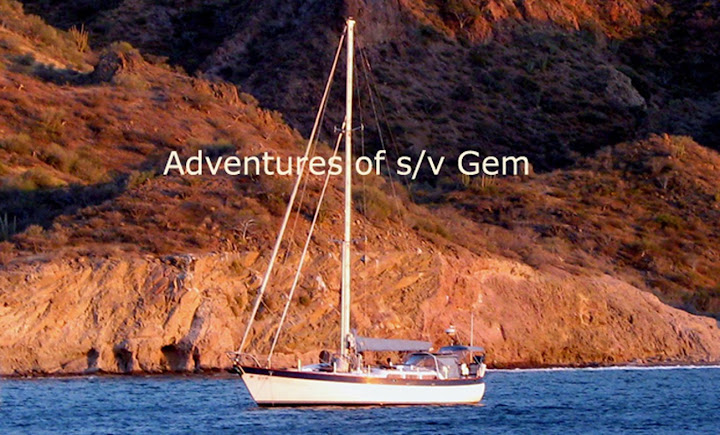
After bottom painting and lots of work, Gem slides back into the water in Guaymas (Western land side of Mexico). Then it's a 1 1/2 day motor/sail to LaPaz (Southern Baja California) with fishing stops in between to meet up with friends before heading south and destinations unknown.

June, July, August, Sepember, October...uh oh...

....it's getting cold here
in the Northwest.
Enough of this house fixing and promoting condos. Time to head south.

New Faces


Proud Grandpa with Kai in Victoria. Parents Jesse and Tia are surely not far away.

Location - Clarification

Just wanted to let everyone know why we ended up in Guaymas. (Location is about a 10 hr. bus ride north of Mazatlan if you know where that is.)

These were the ingredients for the outcome:

1. The cruising area of the Baja Penninsula is so beautiful in the Sea of Cortez side and it takes about 3 months to see it all. (Feb-June)
2. The boat needed bottom paint and Mexico is a good place to do that.
3. The boat needs to be out of the water for about a month in the desert while the blisters dry out.
4. The boat needs work which Biagio will do once the summer isn't so hot...probably in mid October when the temps go down from 140 degrees!
5. Once the water gets to about 80 degrees, hurricane season starts. Therefore the boat needs to stay at the lattitude of about Guaymas or further north to avoid damage.

For all these reason, Guaymas is as far as the boat went. It was all perfect.

Mexico Has Changed in the Last 8 Years


These are some of the changes we noticed in Mexico since the last 8 years we've been here...Newer cars in general for everyone if they have cars, Tricked out bicycles, i.e. extra spending money...Local police on Segways...(gosh, we don't even have Segways for the police in North America last I was there)... and prices that are more expensive than in the past. Good for the Mexicans. They are living better. Worse for our value in the marinas and on the economy. One thing you can always count on is change.

UPDATE: We heard from an economist in Mexico City that the rest of Mexico is probably not doing as well as these cities that we have visited. A guide book of ours hinted at the same conclusion.

Barranca del Cobre or Copper Canyon

This is my third time visiting here. Needless to say, I like it here.

The Copper Canyon is really magnificent. It’s four times larger than the Grand Canyon and one and a half times deeper. The views are spectacular from the train ‘El Chepe’ and there’s hiking throughout the canyon with waterfalls, missions, and museums. The native Tarahumara Indians live throughout the area apart from the Mexican people in their own villages and have an interesting culture of their own.
Our route to get to the canyon from the sailboat included buses from Guaymas to El Fuerte which was a total of 7 hrs riding. The attraction here was that El Fuerte is a quaint riverside colonial town founded in 1563 with 11,000 people. It was built to ward off attacks by native American Indians who the Spanish constantly harassed. Later it was a trading post for silver and gold seekers. El Fuerte (The Fort) - We had a lesson in politics from this entrepreneurial woman who gave us a tour of her house. The revolution of 1910 saw re-appropriation of lands and property. As a result, this used to be one house which is now divided into three houses. This woman bought this section of the original house but had no money to repair the decaying roof and upper floors. She has a tourist shop in the front, lives behind that and raises pigs behind the house.


The next day we rode the train to Creel at 8,000 feet. This was also farthest stop north. Here we learned more about the local Tarahumara Indians, rode bikes and enjoyed the local scenery. Notice the typical Tarahum cave home and and adobe home in the same photo below.


From Creel, we returned a couple of hours south by bus and stayed at a hotel/ranch. Renting horses we ventured into the canyon for a day's ride. It was spectacular.


Horses go much slower than people think. Our 15 year old guide easily beat us to the next look out point via foot power and taking short cuts.

Benjamina Button

On this trip I've gained a nose ring and braces. I feel like Benjamina ..Button. What year is this?

Healthy Mexican Food

(Note: Day 3 on the hard in Guaymas. The hull is halfway done. Biagio is busy with the drummel working away at the ‘spots’, and I'm...well here at the pool. Most of the partners have left for home while the guys do some work on the boat before leaving. I'm still here supplying encouragement, water and food.)

Biagio and I both weigh more than we did when we started this journey. We’re trying to lose a little weight and also look for healthy food when we eat out. The steamed fish and vegetables that comes in foil packets are very healthy. Not very popular but healthy and tasty. Corn tortillas are fairly healthy. They aren’t fried and are made solely from corn flour. We also throw in the occasional hamburger because the Sonora beef is so tasty.
Photos: One block away from the marina, temptation and tasty calories.

Last night after Biagio worked hard on the hull all day, and my many trips gathering things in town, we treated ourselves to a little informal corner restaurant about a block up the street. It’s so popular that people are lined up outside the entrance late at night on the weekends. We concluded that it must be delicious and we needed to try it.

“What’s the most popular thing on the menu?”, we asked the waitress in Spanish. With a big smile on her face, she told us hands down it was ‘papas locas’. “Very good, two orders of crazy potatoes.” We ordered it with horchata. The horchata was delicious, just like a cool bowl of liquid rice pudding running down your through with lots of cinnamon.The crazy potatoes came in a large foil packet that stood up. Inside was small pieces of chopped up beef, potatoes, corn and lots of cheese, butter and cream. Uh oh, we shouldn’t have ordered this. It’s probably very tasty. It was. Cheese, cream and butter. Lots of it. We tried to let it drip through our forks but it was hopeless. So we resigned ourselves to enjoying all those fattening calories and leaving as much cream in the bottom as possible. I can see why it’s so popular. Very tasty. But oh, all those calories!

Sailing Recap - January through October, 2009

Buttoning Up


No……not me…...the boat! The days are counting down now. Our jello plans now indicate that we will leave the boat in 3 weeks. Or 4 weeks. A decision can not be made before its time. Even if it seems like it’s getting down to the wire.


If we work the plan backwards, this is what it looks like: It takes one week to physically ‘stuff the turkey’ (that would be the boat). And then there is a Copper River train trip for one week and a visit to nearby Guaymas. San Diego is only 13 hrs. away by bus for a 5 day visit to Jess and Tracy. And then there’s enjoying the wonderful swimming here in the Bay. Lovely… So put that all in the mix and what do you have? We’re not sure. We’ll just go with the jello plans and decide where we’re going to anchor tonight.

Photo: You have to watch that first step when you need to go to the bathroom in the middle of the night! Biagio is working on the blisters in Guaymas 'marina seca' or dry marina. Interestingly enough, even though this is a city of 130,000 people, this marina is only one block from the start of downtown. Notice the San Fernando Church towers in the main square.


So what is ‘stuffing the turkey’ or ‘buttoning up the boat’? I’m not sure. I’ve never been through one. This is what I’m told is the routine for the boat to be ‘put on the hard’ and blocked up on stands. It needs to dry out because of blisters on the bottom. Then in October it will be prepped and bottom painted. So here's the ‘fun list’:

Photo: As you enter the Bay of Guaymas, you are greeted with perhaps 1,000 old fishing boats like these tucked into every conceivable nook. Some never go out and others are still working.


Sails have to be taken down into the boat, tarps purchased to cover the boat, pop the blisters, take the dodger off, take all the lines in, cover all the furling gear, plug all the through-hole cocks, drain the salt water on the engine and generator, pickle the water maker, make sure all the stored food is wrapped well and there is nothing that could explode, made sure the solar panels are operating to keep the batteries charged, and finally, flush out the water tanks with chlorine. Sounds like fun, huh? In the desert heat!!! I’m not looking forward to that week. Maybe Biagio won’t notice if I hang out in the hopefully cool marine office. He’ll probably notice.


So my job up until that time is to go through the boat and see what I can bring home that I don’t use very much. After sailing for almost a year, there are things that are used and some things not so much. The list leaving the boat includes our golf clubs, extra bathing suits, cold weather gear, some books, etc. Already I can see more free space on the boat. That’s nice.


So parting Gem is bitter sweet. Hopefully, back in the Sea in November but time will tell. You know…that jello thing again…..
Photo upper left: One fishing boat arrested for drugs. On the right: Our view from the fuel dock before going on the hard. Photo above: Guaymas Marina. The fishing boats and fuel dock are on the right side which is where we were docked before hauling out.

This is what the sailing portion of the year looked like:

1 San Diego, Ca – (32 42.6 N, 117 13,8 W) – Starting from here
2 Turtle Bay, Baja, Mex – (27 40.4 N, 114 51.8 W) – 351 n miles - Jan 11, 2009
3 Cabo San Lucas, Baja, Mex – (22 53.2 N, 109 53.9 W) – 405 n miles - Jan 15, 2009
4 Los Frailes & Los Muertos, Baja, Mex – (23 22.8 N, 109 25.6 W) - 48 & 43 n miles - Jan 20, 2009
5 LaPaz, Baja, Mex – (24 07.5 N, 110 22.9 W) – 65 n miles - Jan 25, 2009
6 Partida Cove between Isla Partida & Isla Espiritu Santo, Baja, Mex – (24 32.0 N, 110 22.5 W) – 24 n miles - Feb 15, 2009
7 LaPaz, Baja, Mex - 24 n miles - Feb 21, 2009
8 Isla Espiritu Santo, Baja, Mex – (24 27.1 N, 110 22.8 W) – 20 n miles - Mar 9, 2009
9 Partida Cove between Isla Partida & Isla Espiritu Santo, Baja, Mex – (24 32.0 N, 110 22.5 W) – 5 n miles - Mar 11, 2009
10 Ensenada Grande, Isla partida – (24 33.0 N, 110 23.1 W) - 4 n miles - Mar 15, 2009 (to be closer to the Rookery to dive)
11 Partida Cove again - March 16, 2009 (better anchorage because of the strong winds)
12 Isla San Francisco, Baja, Mex – (24 48.9 N, 110 34.5 W) – 21 n miles - March 18, 2009
13 Isla San Jose, Baja, Mex – (24 51.9 N, 110 34.0 W) – 19 n miles - March 19, 2009
14 Partida Cove again – March 20, 2009 (to get package from Michael & Liz)
15 La Paz again - March 22, 2009 (so close so we went for more food, emails, banking, etc.)
16 Evaristo Bay, Mainland, Baja Mex – (24 55.2 N, 110 43.4 W) – 52 n miles – March 26, 2009
17 Isla San Jose, Baja Mex - (25 01.7 N, 110 42.5 W) - 7 n miles – March 28, 2009 (to get out of the winds at Evaristo Bay)
18 El Gato, Baja Mex – (25 18.0 N 110 56.8 W) - 21 n miles – March 29, 2009
19 Bahia Agua Verde, Baja, Mex – (25 30.8 N, 111 04.8 W) - 19 n miles – April 2, 2009
20 Honeymoon Cove, Danzante Island, Baja, Mex – (25 48.2 N, 111 16.0 W) - 34 n miles – April 5, 2009
21 Puerto Escondido, Baja, Mex – (25 49.2 N, 111 19.0 W) - 4 n miles – April 8, 2009
22 Puerto Ballandra, Isla Carmen, Baja, Mex – (26 00.7 N, 111 10.7 W) – 14 n miles - April 16, 2009 (Two weeks to island hop before Loreto Fest in Puerto Escondido)
23 Salinas Bay, Isla Carmen, Baja, Mex - (25 59.2 N 111 07.1 W) – 8 n miles - April 20, 2009
24 Return to Puerto Ballandra - April 22, 2009 – Weld water heat exchanger on engine with help of power boater Sea Quest
25 Puerto Escondido, Baja, Mex – (25 49.2 N, 111 19.0 W) - 4 n miles – April 28, 2009
27 Isla Coronados, Baja, Mex again– May 8, 2009- near to Loreto for dentist
28 Point Mangle, Baja, Mex – (26 16.4 N, 111 23.8 W) - 14 n miles - May 9, 2009 - moving north
29 Santo Domingo Point, Baja, Mex – (26 51.6 N, 111 52.2 W) - May 10, 2009
30 Mulegé, Baja, Mex – (26 54.1 N, 111 56.9 W) - .7 n miles – May 12, 2009
31 Coyote Bay, Bahia Concepción, Baja, Mex – (26 43.0 N, 111 54.5 W) – 21 n miles – May 13, 2009
32 Santo Domingo Point, Baja, Mex – 21 n miles - May 17, 2009
33 St. Inez Bay, Baja, Mex – (27 03.5 N, 111 58.9 W) – 16 n miles – May 18, 2009, Low pressure coming need to move to shelter
34 Isla Marcos, Baja, Mex – (27 15.6 N, 112 07.4 W) – 7 n miles – May 19, 2009
35 Santa Rosalia, Baja, Mex – (25 60.6 N, 111 58 22.0 W) – 11 n miles - May 21, 2009
36 San Carlos, Mainland, Mex - (27 58.0 N, 111 4.0 W) – 75 n miles - May 31, 2009 - Boat on the hard through summer, Copper Canyon train Mexico, then back to Seattle/Victoria for the summer.

Santa Rosalia to Guaymas on the Mainland (crossing the Sea)

I was captivated by Santa Rosalia. It wasn’t like any other town we visited in our entire time in Mexico. The town was made by a French mining company called El Boleo. Bolitos are little balls here being composed of copper ore that were mined and smelted. Much of it was taken all the way to Tacoma, Washington to be processed. From there, timber would be loaded back into the boats and brought back to Santa Rosalia. In exchange for tax exemption, the French promised to build a town and port.

The result was a town of French Provincial architecture meticulously outlined and adapted to the landscape which is very unlike any other town in Mexico. To me, it feels like living in a ghost town in another place and time. The mine closed in 1954 due to depletion of the mine and the federal government took over supplying employment for the town. It operated for a total of 53 years.


Another beautiful attraction is the transportable church designed by Gustave Eiffel. The church and the Eiffel tower were both exhibited together at the world’s fair of 1889. Being made of steel and rivets, it was designed so that it could be easily transported & assembled in hot climate areas. It would also stand up to humidity, bugs and the elements. After the exposition, the church was disassembled and stored in Brussels never to be mass produced. The executives of El Boleo heard about it and brought it out to Santa Rosalia. It’s a one of a kind and now stands in the center of town since 1897.


After spending a week here, we have more we wanted to say about Santa Rosalia...


Sleuthing Around in Santa Rosalia


The first thing that was odd on our entrance to Santa Rosalia was the enormous grave yard. When you enter the little harbor, greeting you from up on top of the mountain, is a very large white cross. Miles and Miles behind that are burial head stones in a cemetery that goes way back into the valley. Now mind you, this is a small town. So how could you explain a huge cemetery for such a small town?


The second odd thing was that if the French built and occupied this city for 53 years, why is there no trace of them anywhere except for the buildings they left behind? Oh yes, there is one white bust of a French man in one of the small main plazas. But it hasn’t a name or a reference or any explanation of who the man was or what he did. There’s even a small museum with no reference of any French people or those in charge of the mining operation, how they lived, what they did, nothing.


The third odd thing was that the outsides of all these houses are made of beautiful wood from the Northwest of the United States. Why go all the way there to process the minerals and come back with wood? Why didn’t they just process the ore right here in Mexico? Why would they take it to the far ends of a neighboring country?

Photo: The old San Francisco hotel on the left, the ore processing mill in the foreground, on the right a tunnel leading to miles and miles of underground mining tunnels, and cut off on the far right is a large pile of tailings. Not nearly enough for 53 years of work. Most of the tailings are in Tacoma, WA.


You won’t find the answers here in Mexico. But searching on the internet, taking the little bits of history available here, and looking around at what was left behind, Biagio pieced the puzzle together. This is what we believe really happened.


The French had an agreement with the Mexican government for a tax free status of 50 years to extract minerals out of the area. In exchange, the French were to build a town complete with a harbor and houses. This benefited the French because they needed the harbor for their ships and the houses for their business and employees. They built a valley of small inexpensive houses close together for the workers that are no longer standing.


As a result, the French extracted everything they wanted in the way of minerals. Especially the unspoken gold that was never mentioned anywhere. They processed some of the copper here locally but took the bulk of it all the way to Tacoma where they extracted the copper and gold and other minerals from it then shipping the precious minerals to France without the Mexican government knowing exactly what was being extracted, i.e. gold. (Here in Mexico they talk only about the copper ore.) This is the reason they shipped the minerals so far away for processing.


The French grossly ignored safety laws for the workers which ultimately filled the cemetery with bodies; 1,400 workers alone in just a 2 year period. Which is why there is no notation of any specific French person anywhere or the French management or workers in general. Only one bust with no name. That could be putting blame on someone.


So there is beauty and sadness here at the same time. The quaint houses that the French left behind and the large cemetery that tells a different story.


UPDATE: After talking with geologists who know this area very well, we found out that shipping ore to Tacoma is very common and not at all unusual. So we stand correct on that point.

Musings…

The mating season: All that mating that was going on with the birds a few weeks ago has already produced babies. Baby pelicans look like baby geese, and baby seagulls look like baby gray chickens with dark gray markings.
Photo: Near Sanispac, Bahia Concepción. The leeward (less wind) side of a very small island is perfect nesting for pelicans and seagulls. Upper left inset is a newborn pelican and the two birds on the right photo are baby pelicans. Notice how they blend into the rocks.

Stats: Start of trip water temperature in Seattle July 2008 = 53 degrees. Water temperature today in Sea or Cortez May 15, 2009 = 78 degrees; Air temp in the cabin = 93 degrees. Rx= lots of water with showers using the outside shower hose, spray bottle and then stand in front of the fan, the inside shower, swimming and snorkeling.

Rain: When I saw a large school of small fish swimming near the top of the water, they made little circles on top of the water and it looked just like it was raining. I was starting to get excited because we haven’t seen rain for months. I actually miss the rain.

Jellies: Today we went up the river in our dinghy to the very small village called Mulege and saw thousands of very strange aqua colored balls in the water…sort of like a 7” child’s aqua blue bouncing ball. They were fast swimming jellyfish. So we looked up the phylum:

A. There are about 1800 species of jelly fish which are also known as “medusa” as in 1, or plural “medusae”.

B. A swarm of jelly fish is called a “bloom”. It looked like jelly fish were blooming.

Stars: With all the phosphorescence in the water at night, you look up in the sky and see all the stars. Then you look down in the water and see all the stars. Magnificent!


Photos: Finding
precious shade. Biagio's Special toe grip steering. Lower: Tonight's restaurant in the Gulf of Concepción.


Maps: Maps of the Central and Northern Sea of Cortez are so far off that it shows that we are in the middle of Isla San Marcos on top of a mountain. This also means we need to be extra careful of rocks and unknowns when we go to anchor because if they are marked, which they might not be, they will not be where it shows them to be.


A Dry Boat: It doesn’t refer to water coming into the boat or staying out of the boat. It refers to alcohol that may be on the boat. Therefore a dry boat doesn’t do much drinking.


Wine: Here in many towns we visited in Mexico, they put the red wind in the cooler and the white wine on the shelves to be kept warm.


The Birds: If you’ve ever wondered what is would be like to have birds attack you like in the movie ‘The Birds’, all you have to do is walk along a high road up from the water. Seagulls like to make their nests there. As you walk by, they will attack you swooping down on you just like in the movie missing you by millimeters. It will make all your hair stand up.

Trick or Treating for Chocolates in Santo Dominigo (Bahia de Concepción)

So here’s how you do it:


You need a Halloween mask.


And a trick or treat bag.


You look for this special sandy bottom that contains this special treat. It must be a deserted beach and only certain beaches have them. You take the dinghy to shore and jump in about 10 feet of water. Then you dive down with your mask, snorkel and bag to the sandy bottom. When you see a special configuration of two small holes next to each other, you go after them. Don’t go after three holes or one big hole, only 2 small holes. (You never know what’s behind those other unknown holes). Then when those two holes see you overhead, they close up shop and head deeper into the soft sand. You scoop them up with your hand as the sand parts easily and put the little jewel into your trick or treat bag.

There it is, you have chocolates (pronounced: Chock o la tay). Chocolate clams that is. Yummm!

Photo: Snorkeling for chocolate clams. See the brown one in my hand? Interesting shape of the clam inside!

Mom

Sometimes, late at night, after I have watched the sun go down in brilliant colors over the nearest set of mountains, the first star comes out. It’s dusk. Twilight. And there is the lonely, first bright star of the evening.

I look at it and ask, “Mom, where are you and what do you need to tell me?” My next thought is that I can’t believe you’re gone. I still can’t believe that you no longer live on this earth with us. And then I wait for your answer.

Sometimes I understand what I need to know next. Sometimes she just laughs at my wonderings. But she’s always there with the first star that I see. Star light, Star bright.

I’m sad that she’s not so near that I can touch her. But I know she’s always there. Just a star’s touch away. Ready to guide me and answer my questions.

Why did you have to leave now? “Why not,” she answers. “It was my time and it was good.” But what about all those you left behind? “I’m still here,” she assures us. And I believe her.

She is still in our hearts. In our souls. In our beings. She is a part of us. She lives and breathes. She is here. And she is in the stars. She’s out there. She’s in here. I know it’s hard for all of us. But I also know that we have not lost her. She is us. She is here. She is love.

Isla Coronados – (26 06.7 N, 111 17.2 W) – April 24, 2009


The Name of the Sea

The body of water we’ve been spending all this time in has many different names. As large as it is, you would think it would have just one name like The Red Sea or the Gulf of Mexico. But it goes by many names. Most Cruisers refer to it as the Sea of Cortez (referring to Cortez the Spanish explorer) because that is what our navigation and travel guides refer to it as. Or you can say simply ‘The Sea’. The Mexicans who live here laugh at the name Sea of Cortez. They refer to it as the Gulf of California or Golfo de California. For them, it has never been anything else. For my part, I like to refer to things by the name that the people use who live there. I guess they should know best. On the other hand, John Steinbeck’s preference in his famous Log Book was to refer to it as the Sea of Cortez because he thought that sounded more interesting.

There are 900 islands in The Sea. That’s why it’s possible to go only half a mile and find another island with a peaceful cove that has a white sandy beach and a volcano. That is where we are now. On the Island of Coronados. It’s part of the Parque Nacional Bahía de Loreto. So is Isla Carmen, Danzante Island and others. There are about six other sail boats here in the bay and a handful of Mexican panga boats that bring 2-6 passengers each from Loreto for a 20 minute fast boat ride to enjoy the beautiful beach for the afternoon.

There are many endemic species here in The Sea. This is also a migratory ground for humpback whales, California gray whales, Killer Whales, Manta Rays, and the world’s largest animal, the Blue Whale. There are two groups of sea animals migrating here. The first is the group that likes colder water which is this time of year. The whale sharks, California gray whales, and the yellow tail is part of this group. For them to feed on, there is a multitude of krill swimming in the water at this time of year which cuts down on our visibility for diving. The second group will make it’s appearance when the water temperature warms up substantially in June and July. Biagio is looking forward to the second group migration for warmer water and dorado fishing which will be great. So far we’ve caught skip jack tuna, sierra, cod, scallops, and lobster.

Today, April 25, the temperature of the water is a cool and comfortable 73 degrees which is nice to cool off in the water with the air temperature being about 79 degrees in the afternoon. Later on in July and August, the air temperatures will begin to soar to an average temperature in July of 88 degrees, August - 88, September - 85 and October - 80. The result is that the water temperature will be in the 80’s most of the summer. Since it’s spring time, the sea gulls are mating and looking for twigs for their nests near the beach, and the manta rays and rays are also mating doing a dance that ends in the female turning over in the water with their two undersides together. Spring is definitely in the air. And the water.

Schedules

As for us, we need to take the boat out of the water for 2 ½ -3 months because the boat has a couple of blisters on the bottom. First it needs to dry out before a new bottom paint is applied. So that has set our schedule. Staying in The Sea for the summer would be bearable if we were in the water. With the boat being out of the water for such a long period of time, we need to leave the boat or become lizards. So that is the basis for our plans. We will haul the boat out of the water in San Carlos in June or July. The boat will then be ready to bottom paint in October before heading to more southern countries. At least that’s the plan for now. You know those jello plans…before you can even let someone know what you’ve got planned, they have already changed.

Photos: The white sandy beach bay on Isla Coronados near Loreto. It’s spring time in the desert so at a glance, it appears that not much is happening. But if you look closer, you see a profusion of very tiny flowers on most of the plants and cactus.

Puerto Ballandra, Isla Carmen, Baja, Mex – (26 00.7 N, 111 10.7 W) – April 16, 2009

Sometimes pictures can say more...

Fish, Birthday and Shells – April, 2009


Cruising

I thought this definition of ‘cruising’ is very appropriate:

Cruising – A lifestyle that involves living for an extended period of time on a boat while traveling from place to place for pleasure. Cruising generally refers to a trip of a few days or more, and can extend to round-the-world voyages. Wikipedia 2008

Biagio’s monster sierra fish, Jill’s birthday, and shells that are so beautiful you just have to do something with them so I take photographs.

My Car On The Beach

Puerto Escondido, Baja, Mex – (25 49.2 N, 111 19.0 W) – April 8, 2009 – closest marina to Loreto

From Biagio…Puerto Escondido is one of the few hurricane holes in the Sea of Cortez which will protect boats when hurricanes or tropical storms come along. Boats return here year after year to this sheltered anchorage.


Majestic mountains surprisingly tower over us in a desert! While sitting in the cockpit, we can watch the beautiful mountains reflected in the water. This place has drawn me back for it’s great beauty and great memories.

There is another reason boaters come here. The end of the Sea of Cortez boating season will have a big party here for all the cruisers making their way back up the coast returning to the US. It’s called Loreto Fest at the beginning of May. So we’ll be off for a few weeks exploring up north and then return back here for the party.

Honeymoon Cove is just across the way. Only a 15 minute crossing with a beautiful bay that can hold only about 4 boats at a time each one nesting in one of its fingers. It’s not surprising that my crusing friends Terry and Lynn on Starform had talked about this anchorage many times. I missed this on my last trip here. On a typical sunny morning I climbed to the top of one of the hills to take in the beauty of the area.

Look at the photos below to get an idea of the surrounding views.

The Beautiful Surroundings


Why Go to Baja Mexico in the First Place?

Well, Biagio wanted to go here. That’s the main reason. He was here about 10 years ago and it was one of his favorite places that he had cruised in. ‘Why?’, I asked? All he could tell me was there was good diving there. Fine, I like to dive. But the diving has actually been disappointing. The whale sharks were very, very cool. That’s true. But as far as the beautiful reefs and fishes that I have seen in Belize and Cancun, well that just doesn’t exist here. The fish population has severely decreased in the last ten years in large part due to over fishing. And reefs all over the world are decreasing because of the warmer climate. So now that I’ve been here for about five months, would I come back? Absolutely!

The best part of this area of the world is the awesome scenery that we are living in. For me, it’s like someone took the Grand Canyon, filled it up with water and left the mountain ranges visible. Some seem to be painted orange, some red, some the color of gray rocks, and others have bold white bands of striations in them. Each one seems unique. How beautiful they are!!! Every day the beautiful surroundings amazes us. It is awesome!!!

There are four mountain ranges that cover the peninsula with the highest peak being 10,154 feet high. The length of San Diego to the tip of the Baja is twice the length of Florida or 100 miles longer than Italy. Its widest area is 120 miles wide. 65% of the land is desert. It has dozens of bays, lagoons, coves and inlets. This is what attracts the boaters. That plus the air is dry and pleasant like that of San Diego.

With 120 species of cactus to marvel at, the cardón cactus towers above all the other cactus and can grow an incredible height of 60 feet, has a root system of up to 150 feet wide and lives over 400 years old. In the States we have a much smaller cousin of the cardón cactus which is the saguaro cactus.

Here are some of my favorite images that I’ve collected along the way from LaPaz and on up the East coast of the Baja Peninsula which would be the distance of about 60 miles.